
Against self-improvement?

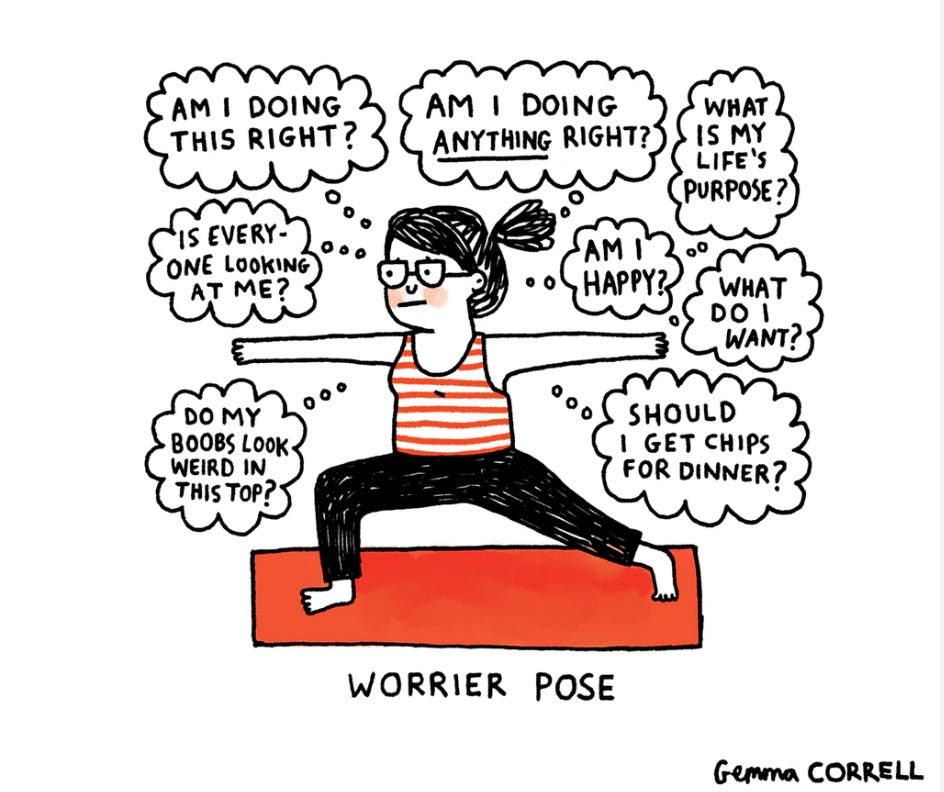
To be American is to be dissatisfied with yourself.
We’re a nation built on the idea of self-improvement, after all. But, as odd as it might sound, I’ve begun to question self-improvement. Or, rather, I question the way we tend to go about it.
My daughter, Simone, recently asked me what my New Year’s resolutions were this year, and I told her I had decided not to make resolutions—for a lot of reasons (hence this essay). I asked her if she’d made resolutions, and she said she wanted to go sky diving this year.
I told her that wasn’t a resolution; it was more of a “joyalution,” as my friend Heather Bourbeau would say. Heather identifies things or experiences that will give her joy each year and then tries to make them happen—to make sure joy is part of her life.
I liked that. I’ve been pondering the nature of New Year’s resolutions and why I now resist them for several years. My main thing is that New Year’s resolutions are so so much about perfecting oneself that they feel like an annual job performance review. One where you don’t get the promotion or the raise.
I actually researched resolutions across cultures, and the American tradition of resolutions is deeply rooted in a cultural cocktail: Puritanism’s emphasis on moral perfectibility, Benjamin Franklin’s relentless self-optimization schemes, and the “pick yourself up by the bootstraps” narrative embedded in the American Dream.
Self-acceptance feels morally suspect to most Americans.
But other cultures approach New Year renewals quite differently. In many East Asian traditions, the emphasis is more on harmony and relationships than individual transformation. Mediterranean and Latin American cultures tend toward more collective, relational goals as well—family gatherings, maintaining connections, enjoying life—rather than the self-directed “new year, new me” transformation narrative.
Self improvement demons
Resolutions so often work against joy because failing to realize them breeds a sense of personal failure.
The statistics of resolution are damningly brutal: studies suggest somewhere around 80% of New Year’s resolutions fail by February. So we have this annual ritual where the vast majority of participants are essentially setting themselves up for failure and self-recrimination.
What makes this particularly insidious is the individualized blame. When resolutions fail, our cultural narrative says that you lacked discipline, willpower, and commitment. The failure is never structural—it’s always personal. But humans aren’t optimization machines. We are creatures connected to others in a complicated and often nettlesome web of life.
Writing stories teaches us this. People’s stories are messy and often shaped by forces beyond individual control. But the resolution culture keeps pushing this fantasy of total self-determination.
Alternative “resolutions”
Per my friend Heather’s concept of “joyalutions,” I’ve been thinking about different pledges that will enhance my experience of your life. Here are a handful to consider:
Choose a word or theme for the year: Instead of concrete goals, select something like “curiosity,” “rest,” “connection,” or “play” as a guiding principle. There’s no failure state—just noticing when you’re aligned with how you want to enhance life or not.
Embodiment: Reconnect with physical experience not for self-improvement but for presence. “I want to feel more alive in my body” looks completely different than “lose 15 pounds.”
Gratitude practices: Reflect on what went well rather than what needs fixing. Writing down things you’re grateful for, or people who mattered to you, reframes the year as abundance rather than deficit.
Be affirmative rather than corrective: Instead of “fix my flaws,” practice “honor what’s already working” or “tend to what brings me alive.”
Permission-giving rather than restriction: “This year I give myself permission to say no” or “to take naps” or “to be a beginner at something.” It’s the opposite of the deprivation mindset most resolutions carry.
Seasonal intentions: Set intentions aligned with natural cycles—spring planting, summer adventure, autumn reflection, winter rest. Try reflections that ask “What delighted me? What did I learn? When did I feel most myself?”
Attention practices: “This year I want to notice...” (beauty, kindness, my own patterns, moments of aliveness). It’s contemplative rather than corrective.
What this means for writers
All of the above “alternalutions” work for writers on the page as well. For example, thinking about topics like “stories I want to tell this year” or “voices I want to listen to” might develop creative inspirations and connections.
For memoir writers specifically, consider topics like: “Whose story wants to be told through me this year?” It makes you a vessel rather than a self-improvement project.
Since I’m putting on an event that carries with it the spirit of resolutions in Memoir Nation’s JanYourStory (a challenge to write 500 words per day in January), I’m sensitive to making the event too much about self-improvement and not about the fundamental joy of writing to find meaning and connection.
I hope that the challenge to write 500 words per day opens a path that takes you through all of those “alternalutions” above. The 500 words per day isn’t about a strict regimen of self-improvement—but a quest for meaning and joy and connection through our stories.
Personally, I’m telling myself that I’ll write every morning not to finish a book or get published, but because I want to re-discover how the practice of writing nourishes something essential in me. I’m reclaiming myself by making time for writing.
My big question is: “What do I want to discover about myself this year?”
Discovery implies curiosity and adventure. “Have patience with everything unresolved in your heart and try to love the questions themselves,” said Rainer Maria Rilke.
Writing prompt
“What do you want to discover about yourself this year?”

Please help me publish this newsletter?
Because a quote
You do not have to be good.
You do not have to walk on your knees
for a hundred miles through the desert repenting.
You only have to let the soft animal of your body
love what it loves.

 —Mary Oliver,  from "Wild Geese"
Because I love Amanda Knox
One of the most profound experiences of my 2025 was interviewing Amanda Knox on the Memoir Nation podcast and reading her recent memoir, Free. We’re so lucky that she’s returning to teach a class on reclaiming your story for Memoir Nation.

Join me for a creative retreat in Italy!


We were 100% booked for our creative retreat in Italy this coming April, but one person has had to cancel, so join us! Artist Karima Cammell, guest musician Raphaella Hero, and I are gathering at a castle outside of Turin from April 7–16 for a week of deep creative exploration.
Because a photo

The above photo is from my new book, something out there in the distance. It consists of a series of linked “short-shorts” written to my friend Gail Butensky’s wonderful photos. I hope you’ll buy my book.
At 81, I'm accepting being in the twilight of my years here and how to be aware of every moment.
So, the first time I ever made a New Years Resolution was in my 68th year. I resolved to change my attitude/s. It's the only resolution I ever made and I've been renewing it every year since. That'd be almost 10 years! Yikes! I'll be working on this one right up to my grave site (& beyond, prob'ly.) Anyway, it keeps me young at heart to continue shifting attitudes as I navigate life changes.
May luck and pluck be yours in 2026, Grant! (I'm no longer comfortable w/ the words Happy New Year. Am thinking we're gonna' need lotsa' luck & pluck to get to the next presidential election.)