
Writing the Hard Thing

I always say it’s a writer’s duty to be vulnerable on the page, to write about taboos, to spelunk into the darkness, unearth the dead—whatever it takes to write this nettlesome, knotty, slippery, sharp thing known as the truth.
It’s a risky duty, to be sure. Punishing. Sometimes unappreciated. Sometimes even damning.
There are few worse things than the fear of being ostracized—to be shamed and banished. To feel alone and alienated. We’re a group species after all. We seek love and belonging above all else.
But if we’re not in search of writing the truth—no, in training to write the truth—then what are we doing in this business of writing?
In training because you have to constantly practice using your truth muscles, building your muscles, and then, finally, performing with them.
Performing. Which means going public. Because while speaking truth might cause banishment, it is also ironically the path toward love and belonging. The truth is its own type of blanket, it own kind of nourishment.
I recently published an excerpt from my memoir—Heart Failure: The Story of a Maniac—a story about myself that I’d scarcely told anyone during my 61 years on this planet. The wonderful writer and brave truth teller Jessy Easton, who publishes the Substack After/Words, publishes a feature called, On Writing the Hard Thing, and she asked me to contribute a piece to it.
So I had to live up to all of my words that I preach to others and publish a piece on a taboo subject. It was hard. I didn’t know what to expect after Jessy published it. I was nervous the night beforehand, and then the morning I woke, I wanted to take it back.
But I’ve been wondefully gratified. Because I connected to people on a deep level, both friends and strangers. Because we shared something that forms the deepest part of who we are, and we became a little more human together as a result.
Here goes …
The killing of oneself. A tendency.
1
I can’t remember a time in my life when I didn’t think of committing suicide.
2
One night, when I was eight years old, I dressed in my snow boots and my winter jacket, and I walked out into the back yard and lay down in the snow and made a snow angel. Except I wasn’t there to make a snow angel. I wanted to freeze to death. I lay in the snow, the darkness enveloping me, and I decided I would lie there until I died.
I don’t think there was any particular catalyst for this. I don’t remember being wronged or unjustly punished. I just remember the pull of death. It’s a pull that has always seemed hard wired into me because I’ve never not felt it. I didn’t know it was odd for an eight-year-old to think about suicide.
I lay in the darkness, the cold snow snuggling into my back, and I stared at the warm orbs of light in my house as the chill needled my cheeks. I was separate from it all, drifting in my own orbit. I lay outside for an hour or so, waiting to die, but then I got bored and hungry and went back inside. Still, I remember finding a strange peace in that hour. A solace I didn’t know how to describe.
It’s funny because if you met me, you wouldn’t think of me as having any of the warning signs of suicide. I’m jolly, gregarious, adventurous, loving, giving. I like to crack jokes. I like to stir things up. I like to tease and banter. I like to bring people together. I enjoy my life.
I’ve never thought of myself as having more than the usual angst of a writer. To be a thinker is to be anguished in some way, by definition, but I never thought my anguish led me to a too-dark place. I love reading the existentialist philosophers, but I wasn’t a Kafka or a Nietzche by disposition. I drank a lot, of everything, but I thought of my drinking as hearty drinking, living with gusto, and I exercised in similar ways, with an intensity that spoke of liveliness to me. I was a long-distance runner. I was a person who endured.
And yet I’ve imagined dying by my own hand for a lifetime. My life has been a type of suicide watch. I’ve thought about it every day, and in all sorts of scenarios—by gun, by pills, by slicing veins, by needle, by jumping. What most people can’t fathom is that my thoughts of dying, as horrific as they might seem, have also been comforting.
Release. Relief. The need to disappear. To be elsewhere. The need for quiet. To be at peace.
The idea of suicide has actually been a kind of lifetime companion, an unacknowledged friend. When I’ve thought of suicide, it’s as if I’m turning a valve, calibrating whatever hurt and sequestered rage or shame is within me, and turning it to let the pressure out. “The thought of suicide is a great consolation: by means of it one gets through many a dark night,” said Friedrich Nietzsche.
I have often gone to sleep imagining my death. In the beginning of the night. In the middle of the night. At the end of the night.
Here’s my existential paradox: I will want to die until the moment before I die.
3
In high school, I began cutting myself. In moments of anguish, in moments of drunkenness and rage, in moments of shame, I’d hold a pair of scissors to my forearm, press the blade into my flesh, and then … the rush of the slice through the skin—relief, like a breath, as I watched the blood rise and fill my wound.
One pain takes over another pain.
The difference between cutting and suicide is about intent. To cut is not to intend to die, but to seek relief.
But suicide is also a search for relief.
I hid the slice marks on my forearm by wearing long sleeved shirts, yet I wanted the world to see them.
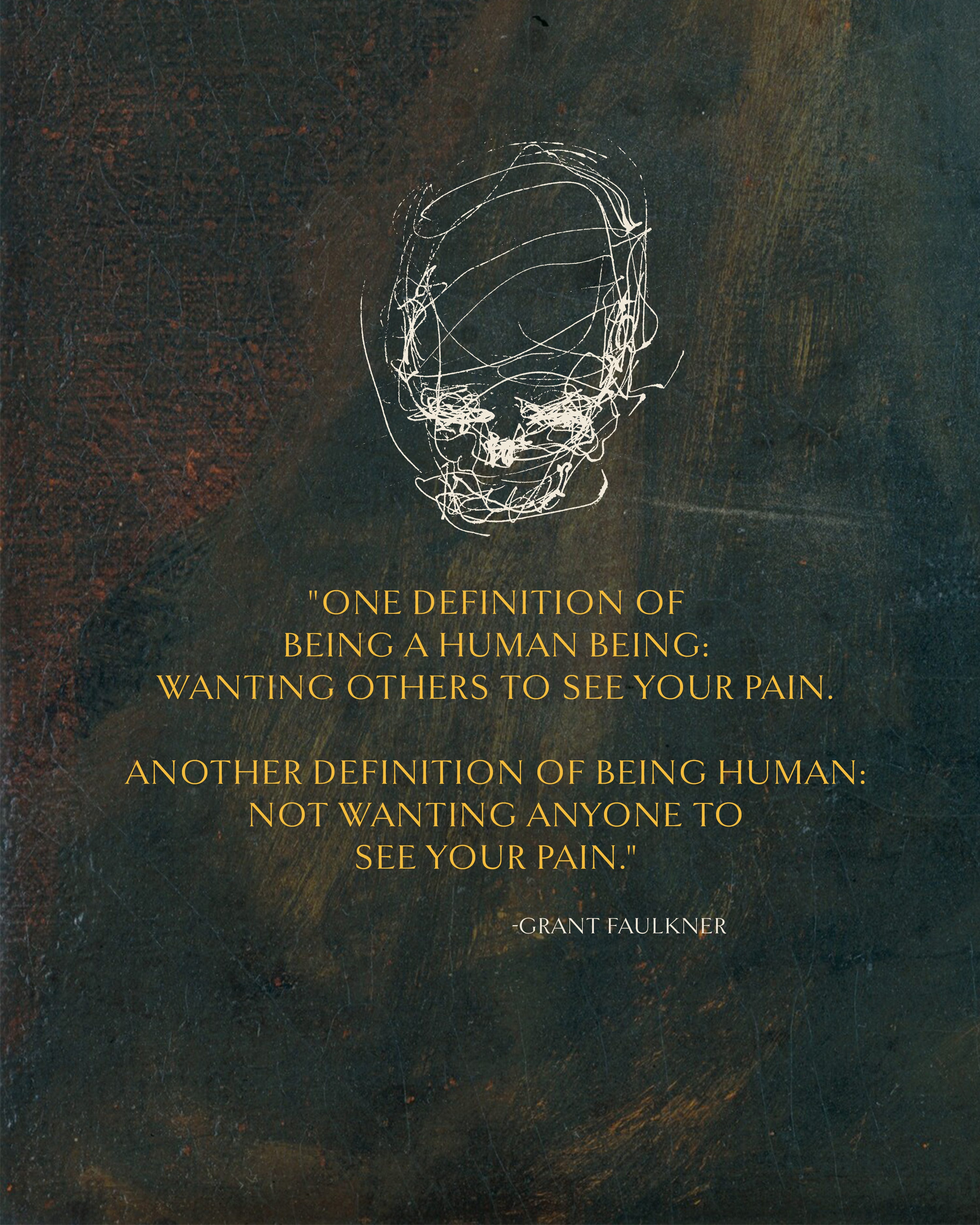
One definition of being a human being: wanting others to see your pain.
Another definition of being human: not wanting anyone to see your pain.
Both definitions were true for me at the same time.
4
One pain takes over another pain.
I ran cross-country in high school for the pain. I chanted, “Kill the hill,” as I pushed my body up each hill. I loved to pass the runner ahead of me midway up a hill. I loved running hard and long because I loved that I could ride the pain, thrive on the pain, endure more pain than others. I flogged myself with each stride. And after a while, I started to float, even as I heaved for each breath, creating a new pain, a new solace, with each desperate lunge of my step. I ran to die.
5
Suicide. Originating from the Latin sui “of oneself” and -cidium “a killing,” suicide means the deliberate act of killing oneself.
A killing of oneself.
Except it’s also an expression of oneself.
A feeling beyond words.
It’s an escape of oneself.
Or an escape from life.
It’s a quest.
It’s a blanket.
It’s a destination.
It’s a surrender.
It’s a salvation.
6
“I have always believed that, between living and dying, from being to being no longer, there are secrets understood by those nearer death,” said Yiyun Li.
7
Science: When a person cuts compulsively, the brain begins to associate the experience with relief. As tension builds, the body begins to crave the feeling it experiences during cutting.
Religion: Many people have flogged themselves as a means of penance for their sins. Self-flagellation—a means to reach the sacred, a means to find peace.
We search in death for the things we cannot find in life.
Perhaps I cut myself because I was paying for my sins. The sin of being me.
Perhaps death, especially killing oneself, is the ultimate surrender. That’s what I’ve been looking for my entire life: surrender. Surrender of self. Surrender of ego. Surrender as a way to reach something higher.
8
How do you tell anyone that you have suicidal tendencies?
“Good morning. How are you?”
“I’m good. I’ve been imagining sticking a gun in my mouth and pulling the trigger for the better part of this morning.”
I have never wanted to talk to anyone on a suicide hotline about this. I have never wanted to be rushed to the emergency room.
It’s too much a part of me. And I’ve always been fine with that part of me. Because I know I will never commit suicide. Even when I don’t know if I will commit suicide, I know I won’t commit suicide. Because I’ve thought about it so much. I’ve thought about suicide too much to do it.
9
“The worst part of having a mental illness is people expect you to behave as if you don’t.”
— The Joker
10
Quiet. I just want quiet.
My hurt head. My bad head. There’s a drill in it. A drill on the loose. The only thing that quiets it is booze. I’m sorry, but I need the quiet. And the place to find it is in the booze. And whatever else is at hand. Whatever will soften. Whatever will soothe these jagged thoughts that rip through my mind, cutting up everything in their path. How to describe it? A traffic jam in my head. A racetrack. A war of knots and pricks, pinches and prods. A cauldron of mixed metaphors.
I take an edible. I take a drink. I take another drink. I take another drink.
11
The movie Ordinary People came out when I was 16. I’d never felt myself so intensely in a story than as Timothy Hutton’s Conrad. The film is about a wealthy suburban family unraveling in the wake of a boating accident that killed their older son. Hutton plays Conrad, the surviving younger brother. He looks so jittery and pale and sleep-deprived that he appears as if he has forgotten how to inhabit his own body. He’s hunched, watchful, as though he’s taking up too much space. I felt myself in the way his eyes tracked a room before he entered it, the way he flinched before he answered a question.
My friend Sid (not his real name) and I went to see the film over and over again. Sid was the only person I’d told about my suicidal thoughts. He’d had the same thoughts. We recognized each other as fellow suicidal travelers. The brotherhood of suicidals. I can always spot them. It’s my “suicidar.” We started dressing like Timothy Hutton did in the movie. We wanted to see a therapist like he did. Of course there were no therapists in Oskaloosa, Iowa. There wasn’t even a suicide hotline back then, in the early 80s.
Our favorite band was Joy Division, and Ian Curtis, their singer, was all the more legendary to us because he had committed suicide. He hung himself in the kitchen of his home in Macclesfield, England. He was 23 years old. Joy Division was scheduled to leave for their first American tour the next day.
The night before his suicide, he’d spent the evening alone. His wife had taken their young daughter to her parents’ house after another difficult period in their marriage. He watched Werner Herzog’s Stroszek, a bleak film that ends with a suicide, and listened to Iggy Pop’s The Idiot repeatedly. He left the record player on.
He performed his suicide through his music:
“I’ve been waiting for a guide to come and take me by the hand” (“Disorder”).
“Where has all the passion gone? / Or is it still newly wed?” (“Love Will Tear Us Apart”).
“This is the crisis I knew had to come / Destroying the balance I’d kept” (“Twenty Four Hours”).
Sid and I drove for hours listening to Joy Division, drinking quarts of beer, smoking pot. Friends described Curtis as someone who refused help, who seemed determined to experience everything at maximum intensity. He wouldn’t moderate drinking despite how it triggered his epileptic seizures. Bernard Sumner, a guitarist with Joy Division, later said Curtis seemed to be “living on the edge” deliberately.
12
My question: where would anyone want to live other than the edge?
13
“The frequent attempt to conceal mental pain increases the burden: it is easier to say ‘My tooth is aching’ than to say ‘My heart is broken.’”
— C.S. Lewis
14
We don’t have a good vocabulary for suicide. The language we do have is either clinical and sanitizing, religious and condemning, or euphemistic—“took his own life,” “lost her battle.” For centuries in Western culture, suicide was classified as a mortal sin—the gravest possible offense against God. God gave us life, after all. And a suicide has the audacity to say, “Fuck you, God, I don’t want the life you gave me.”
Bodies of people who died by suicide were denied burial in consecrated ground. This theological condemnation created a cultural sentiment that persists today, even in secular contexts. There’s a sense that there’s something wrong or shameful about the subject of suicide itself.
15
My bruised brain. I live with an ache. A sad ache. A yearning ache. A melancholic ache. But now I also live with loads of anxiety. Anxiety that has been accumulating for years. Anxiety that batters and pokes and yells. Anxiety that bangs all around looking for something but can’t find it. Anxiety that holds an ice pick.
16
Most suicide attempts are impulsive. Studies of Golden Gate Bridge survivors show that 90% didn’t go on to die by suicide.
“I instantly realized that everything in my life that I’d thought was unfixable was totally fixable—except for having just jumped,” said Ken Baldwin, a Golden Gate Bridge jump survivor.
17
I have wondered, is being a writer an act of suicide, even as it is an attempt to live forever?
That’s what so many suicides seek, right? To live forever in others’ thoughts. To leave life with an eternal question: Why?
A suicide’s muted cry: you did not care for me enough.
Except it’s a loud cry, loud not in sound, but in intensity, an echo that never quits crying.
Suicide is a ripping off of a mask. Just as writing a memoir is the ripping off of a mask. And putting on a different mask, perhaps.
18
Suicide’s Note
By Langston Hughes
The calm,
Cool face of the river
Asked me for a kiss.
Coda
Nearly two years ago, I asked my doctor for anti-anxiety medicine. Upon further examination, my doctor theorized that I’d suffered from chronic depression my entire life. She diagnosed Lexapro, an anti-depressant, and it was like turning on a light. Not only did the weight of my depression lift, but the suicidal ideation lessened to a degree I had never experienced. Now I rarely think of suicide at all.
Jessy also did a wonderful interview with my about writing the hard thing.

Please become a paid subscriber …
Because a quote
“Write straight into the emotional center of things. Write toward vulnerability. Risk being unliked.”
—Anne Lamott
Because buy my books!

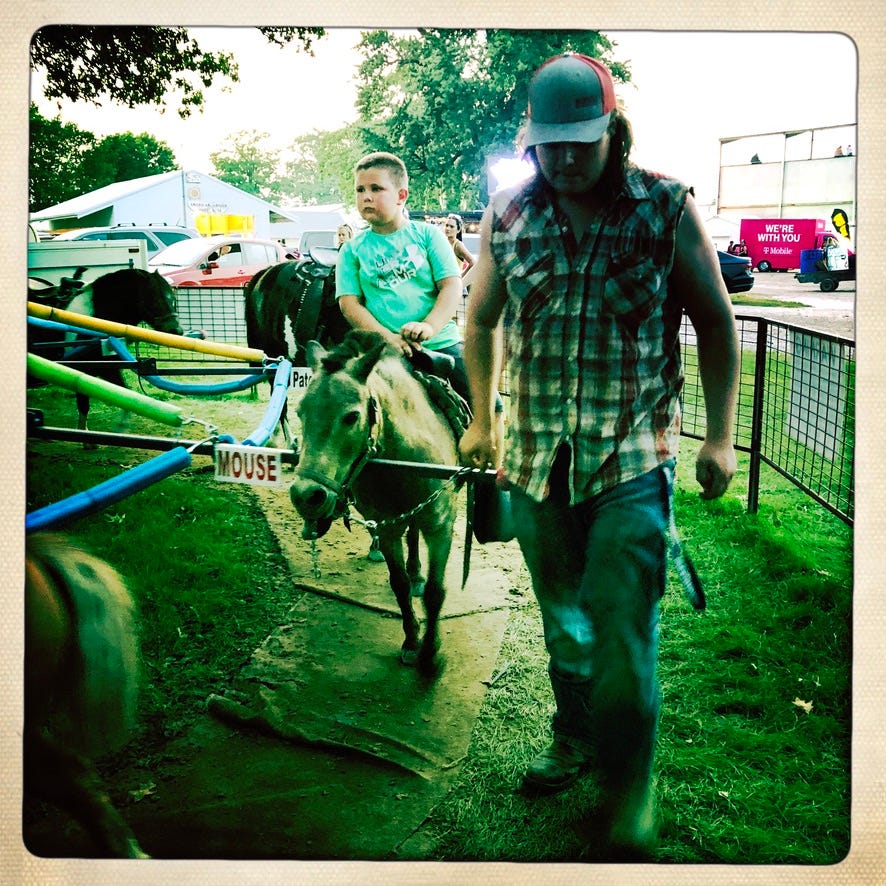
Because a photo prompt
The Southern Iowa Fair in my hometown, Oskaloosa, Iowa.
Somehow, almost two years ago now, the universe led me to Nothing Short of 100 which led me to 100 Word Story which led me to The Art of Brevity and, of course, to you, Grant Faulkner. How grateful am I for all of that? I know I'm just one soul of many who connect to your words almost every single time. Thank you, Grant, for all of those words. I'm in line to sit next to you... to just sit... do nothing... other than just listen, laugh, feel comforted.
Thank you for your vulnerability Grant ♥️ Holding you tight.
You’re an inspiration, my friend.
(When my doctor prescribed a low dose of Lexapro during the pandemic, it slowed down my constant spiraling anxiety, which I’d had since I was a kid.)